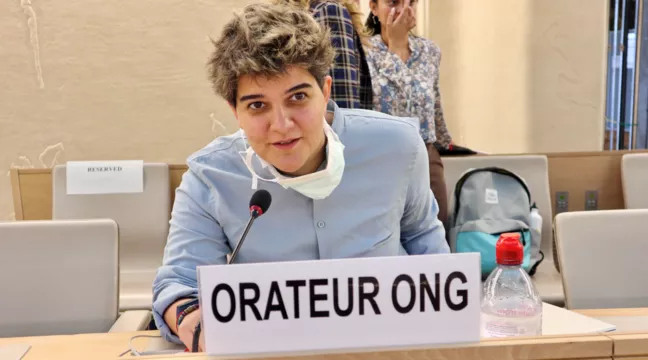
From protests in the streets of Tbilisi to negotiations at the UN
Anika Tizliarishvili's strong commitment to gender equality issues began at a young age. She first showed her dissatisfaction by protesting in the streets of Tbilisi. Now she has a chance to make her voice heard at the Human Rights Council in Geneva.
When Anika's grandmother was young, she was kidnapped by a man who literally wanted to take her as a bride. It was a common practice in Georgia at the time. And it still happens today. Since the abducted girl risks bringing dishonour on her family, she has no choice but to accept the forced proposal. But Anika's grandmother stood her ground and refused to marry a man she did not like, despite the shame she risked.
"My grandmother is truly my great role model. It's very much thanks to her that I've become such a convinced feminist," says Anika.
Bride kidnapping
Despite being banned since 2017, Georgia has among the highest rates of child marriage in Europe. Bride kidnapping still occurs. Georgia's Interior Ministry registered 34 such cases in January to September 2020, but the underreporting may be high.
Source: equalitynow.org
Already as a child, Anika Tizliarishvili realised that men and women were not equal. At school, boys were considered innately gifted, while girls had to study for knowledge. When she got older and started working, she was paid less than a male colleague with the same tasks and responsibilities, explaining that he had a family to support.
"There is always a reason to demonstrate"
The feminist fight led Anika to the streets of Tbilisi to protest. And although she now has a paid job at an organisation that promotes the issues close to her heart, she is not giving up her activism.
"There's always a reason to demonstrate in Georgia," she says.
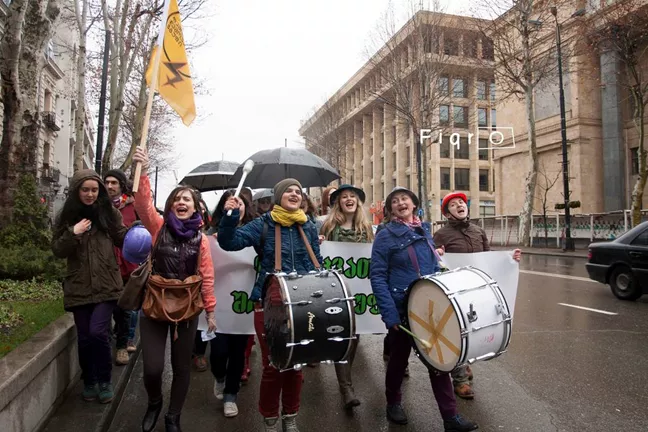
In 2010, the protests were about the Patriarchate's (right-wing elements of the Orthodox Church) proposal to ban abortion. Anika and her friends took to the streets to show their displeasure. At one point, about 20 young protesters were met by 200 older men dressed in black who shouted at them. The loud protest against the Orthodox Church's strongly backward-looking message attracted a lot of attention. For the first time, feminists became visible in the public space, bringing more people, including the older generation of women, to join the protests.
"My mother never understood my feminist struggle. But in this we agreed. Today, she has a much better understanding of the issues I'm fighting for and is on my side. My dad is completely silent, but we both know it's his way of supporting me."
Changing the law on domestic violence
The feminist movement in Georgia grew by leaps and bounds, and at one demonstration, just a few years after Anika and her friends first came out, nearly 7,000 people attended. That same year, 27 women had been killed by their partners or ex-partners. Now the demonstrators gathered outside parliament to raise awareness of the issue of domestic violence. And the demonstration produced concrete political results: a no-visit clause was added to the law on domestic violence.
"It's such an incredibly liberating feeling to work for a good cause and see change come through. A feeling of really being able to improve the world. It has pushed me to do even more, even better, to create a better life for everyone."
Gender stereotypes affect children
For a few years now, Anika has been working full-time for women's rights, as PR and Communications Officer at the Partnership for Human Rights. The organisation pursues strategic legal cases to bring about systemic change. Her experience here came in handy when she recently accompanied the RFSU's Learning for Change network to Geneva. Together with some of the other participants from different parts of the world, she formulated an RFSU statement, which she then delivered:
"Studies show that girls begin to be influenced by harmful gender stereotypes at the age of six. At this point, girls begin to question their own intelligence. This affects their decision-making in all areas of their lives, including career choices and how and to what extent they are entitled to participate in public life. This should change now!"
Anika's grandmother passed away a few years ago. But she would probably have been very proud that her granddaughter took the feminist struggle all the way from the streets of Tbilisi to decision-making rooms at the international level.
Article: Ulrika Hammar