
How do we work?
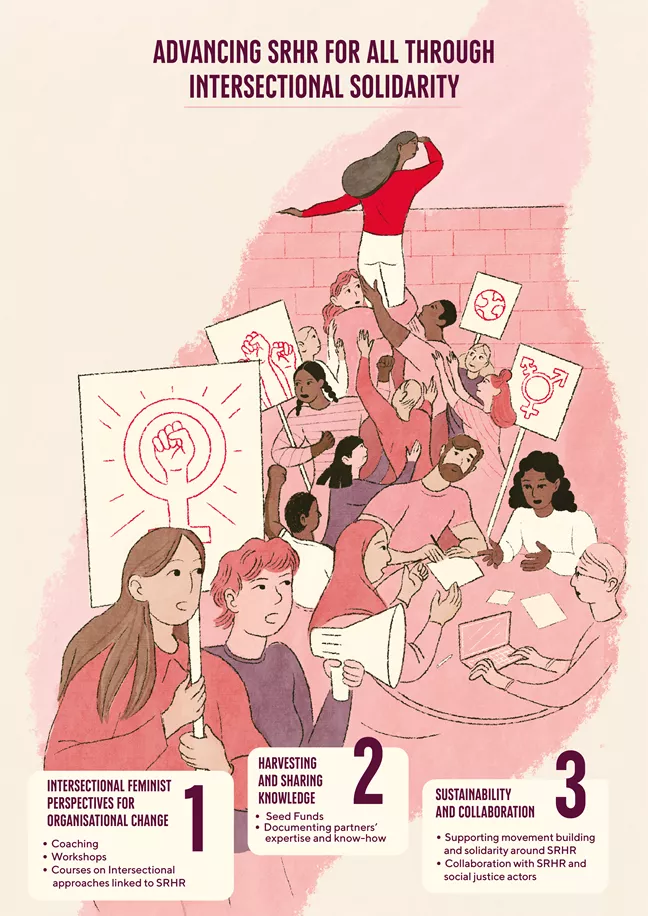
RFSU's Programme framework Challenging Power, Privilege and Oppression describes our approach to advance intersectionality in practice, organising our work with partners and allies into three work streams.
Here you can find Challenging Power, Privilege and Oppression
1. Intersectional Feminist Perspectives for Organisational Change
RFSU follows a hands-on approach to both learn from, and provide support to strengthen partners' technical capacity by creating the space for exchanging expertise and/or providing tailor-made coaching in areas of work pre-identified by partners. RFSU does NOT provide unsolicited capacity building on intersectionality. Our approach departs from the know-how of partners and is designed in close consultation with and buy-in from partners.
2. Harvesting and Sharing Knowledge, Learnings and Evidence
RFSU allocates seed funds to partner organisations, to strengthen and document their intersectional practice. In addition, RFSU values partners’ expertise and know-how on intersectional practice, to this end, we facilitate reflection, documentation of partners’ practice and exchanges among other partners.
3. Programme sustainability and collaboration
In a context of shrinking civic space, where work with gender equality, SRHR, anti-racism, diversity and inclusion is under threat, RFSU sees it as even more important to recognise the value of adopting intersectional perspectives as a way of promoting movement building and solidarity around SRHR.
Translating intersectional feminist perspectives into practice
RFSU has worked since 2017 on translating intersectional feminist perspectives (IFP) into practice together with partners and allies. This work has included:
- A pilot program in Latin America with Fós Feminista, Católicas por el Derecho a Decidir (CDD) Bolivia, and ProFamilia in Colombia. The organisations explored ways of taking intersectional feminist perspectives seriously internally in their organisations as well as in external programs.
- The design and execution of study circles and in-depth courses and e-learning on intersectional feminist perspectives on SRHR for partners and RFSU staff.
- Around 30 tailor-made coaching processes for partners expressing an interest in such support.
- Adjusting RFSU’s internal steering documents to ensure that intersectional power dynamics are considered in assessments of funding applications and projects. In addition, intersectional feminist and anti-racist perspectives have been integrated into RFSUs steering documents.
- Provision of seed funding to partner organisations wishing to develop intersectional feminist work
- Supporting partners to reflect on their intersectional feminist practice through documentation of case studies and learnings, and production of studies and other knowledge material.